
- Providing world class service and value for employee benefit group plans since 1987

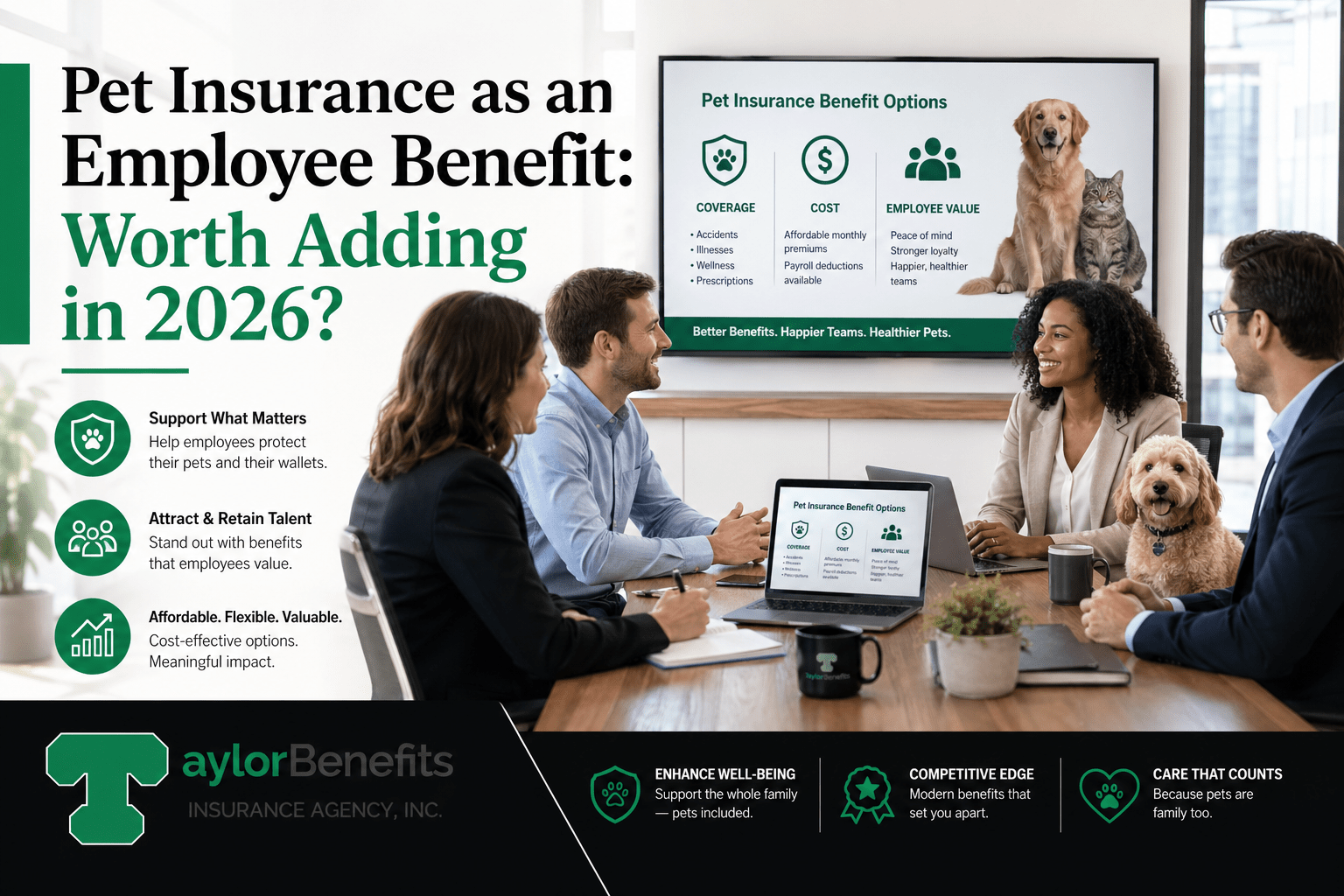
Five years ago, pet insurance as an employee benefit was a curiosity — a perk offered by a small number of pet-friendly employers and largely absent from mainstream benefits packages. In 2026, it is one of the fastest-growing voluntary benefits in the U.S. employer market, offered by a meaningful percentage of large employers and increasingly common in mid-market benefits packages as well.
The growth isn’t accidental. American pet ownership has expanded substantially, with roughly two-thirds of U.S. households now owning at least one pet. Veterinary care costs have risen materially over the past decade — outpacing general inflation in most years — driven by advances in veterinary medicine, the availability of specialty and emergency veterinary care, and the willingness of pet owners to pursue treatment options that didn’t exist a generation ago. And generational shifts in how employees think about pets — particularly among millennial and Gen Z employees who increasingly classify pets as family members — have changed the conversation about what counts as a meaningful workplace benefit.
For employers evaluating whether to add pet insurance to their benefits package for 2026, the relevant question is not whether the benefit is popular — it is. The question is whether it earns a place in the package: whether it adds enough value to recruitment, retention, and employee satisfaction to justify the administrative effort and the opportunity cost of focus on other potential benefit additions. This article walks through that decision honestly.
Before evaluating the benefit, it helps to be precise about what employees are actually buying when they enroll. Pet insurance products vary across carriers, but most fall into three general coverage categories:
Accident-only coverage. The most basic and least expensive tier. Covers veterinary costs related to accidents — broken bones, lacerations, ingestion of foreign objects, vehicular injuries — but excludes illness-related care. Premiums are typically modest, often $10 to $20 per pet per month for dogs and somewhat less for cats.
Accident and illness coverage. The most common coverage tier. Includes accident-related care plus illnesses — cancer treatment, diabetes management, infections, chronic conditions, prescription medications. Premium pricing varies widely based on pet age, breed, and geographic location, but typically ranges from $25 to $60 per month for dogs and $15 to $35 per month for cats.
Comprehensive coverage with wellness add-ons. Combines accident and illness coverage with optional wellness components — annual exams, vaccinations, dental cleanings, flea and tick prevention. Premiums for comprehensive coverage with wellness can run $50 to $100+ per month per pet.
Pet insurance plans typically operate on a reimbursement model rather than a network model. The employee pays the veterinary bill at the point of service, then submits a claim to the carrier for reimbursement of the covered portion (typically 70 to 90 percent of covered expenses after the deductible). This is structurally different from human health insurance and is worth communicating clearly to employees evaluating the benefit.
Pre-existing conditions are typically excluded from coverage in pet insurance — a meaningful limitation that affects what value the benefit delivers to employees with older pets or pets with established health conditions.
Almost all employer-sponsored pet insurance is structured as a voluntary benefit — meaning the employer arranges access to the carrier and facilitates payroll deduction, but employees pay the full premium themselves. The employer’s direct cost is essentially zero beyond the administrative effort of adding the benefit to the program.
This is the standard model for several reasons. First, pet insurance does not qualify for pre-tax payroll deduction under Section 125 cafeteria plans — premiums must be paid with after-tax dollars. Second, the variation in pet ownership across the workforce (some employees have multiple pets, some have none) makes employer subsidization administratively complex and difficult to justify equitably. Third, the value to employees comes substantially from group rate access and payroll convenience rather than from employer subsidization.
A small number of employers — primarily large enterprises with strong pet-friendly cultures — offer modest employer contributions toward pet insurance premiums or include pet insurance contributions in lifestyle spending account (LSA) frameworks. This remains uncommon and typically applies only at the upper end of the market.
The standard implementation involves:
The administrative effort is modest. The implementation timeline is typically 60 to 90 days from carrier selection to benefit launch.
The value pet insurance delivers to employees comes from three sources that are worth distinguishing.
Employer-sponsored pet insurance is typically offered at group rates that may be modestly below individual market pricing. The savings versus individual market pricing are usually meaningful but not dramatic — typically 5 to 15 percent — because pet insurance pricing is driven primarily by pet-specific factors (species, breed, age) rather than by group purchasing dynamics in the way that human health insurance is.
In some cases, employer-sponsored programs offer simplified underwriting or reduced waiting periods compared to individual market products — modest practical advantages that may matter to employees with pets.
Payroll deduction simplifies premium payment and prevents lapsed coverage from missed payments. For employees who have evaluated pet insurance individually but not enrolled because of the friction of setting up the relationship, payroll deduction availability can be the differentiator that converts interest into action.
The pet insurance market includes a wide range of carriers with substantial variation in coverage quality, claims handling, and customer service. Employers who select a reputable carrier through a benefits-focused process effectively curate the marketplace for employees, reducing the research burden of selecting an individual policy.

The strategic case for adding pet insurance to a benefits package centers on recruitment and retention — particularly among workforce demographics where pet ownership is highest and where pet care responsibilities materially affect employee priorities.
Pet ownership is highest among millennials and Gen Z, who collectively represent a substantial and growing share of the workforce. These cohorts also report higher rates of treating pets as family members, higher rates of paying for veterinary care that prior generations might have foregone, and higher receptivity to employers who acknowledge pets as part of employees’ lives.
For employers competing for talent in cohorts where pet ownership is high — technology, professional services, healthcare, education, and most knowledge work sectors — pet insurance has moved from a curiosity to an expected component of competitive benefits packages, particularly at the larger employer end of the market.
Pet insurance shows up in employer benefits comparisons that recruitment platforms increasingly publish. For employers evaluated by candidates against competitors with comparable medical, dental, and retirement benefits, pet insurance can serve as a tangible differentiation point — particularly when paired with other pet-friendly workplace policies (pet-friendly office days, pet bereavement leave, pet adoption assistance).
This differentiation effect is most meaningful when the rest of the benefits package is competitive on the foundational categories. Pet insurance does not compensate for weak medical coverage or below-market retirement matching. It supplements an already-competitive package.
Beyond direct utilization value, pet insurance — like several other category-specific voluntary benefits — signals that the employer recognizes employees as whole people with lives that extend beyond work. The cultural signaling effect is real but difficult to monetize precisely.
For employers actively building employer brand around treating employees as individuals rather than interchangeable resources, voluntary benefits that address specific dimensions of employee life — pet care, financial wellness, caregiving support, identity protection — collectively contribute to that brand more than any single benefit does on its own.
The honest assessment of when to add pet insurance to a benefits package depends on several factors specific to the employer’s situation.
Employers in industries and locations with high pet ownership rates among the workforce. Technology, professional services, healthcare, education, and creative industries typically have workforces with above-average pet ownership rates. Geographic markets with high pet ownership (most U.S. metropolitan areas, but particularly West Coast and some Sun Belt markets) reinforce the pattern.
Employers actively competing for millennial and Gen Z talent. These cohorts both represent the largest pet-owning demographic and the workforce segments where category-specific voluntary benefits matter most for employer brand differentiation.
Employers with mature voluntary benefits programs. Pet insurance fits naturally into a benefits package that already includes other voluntary benefits like accident insurance, critical illness, hospital indemnity, legal insurance, and identity protection. Adding pet insurance to a robust voluntary benefits offering is administratively simple. Adding it as the only voluntary benefit alongside core medical and dental requires more standalone justification.
Employers using benefits administration platforms that simplify voluntary benefit administration. The administrative cost of adding pet insurance is meaningfully different on a modern benefits administration platform (where the marginal cost approaches zero) versus in a manual benefits administration environment.
Employers with strong pet-friendly cultural elements already in place. Pet insurance reinforces and signals other pet-friendly workplace policies. For employers with pet-friendly offices, pet bereavement leave, or pet-related employee resource groups, pet insurance is a natural extension. For employers without those elements, pet insurance can stand alone but loses some of its cultural signaling value.

Employers whose foundational benefits aren’t yet competitive. Adding pet insurance while medical contributions are below market, retirement matching is weak, or mental health benefits are inadequate prioritizes a niche benefit over foundational ones. Get the foundation right first.
Employers with predominantly older or industrial workforces where pet ownership rates are lower. The benefit’s recruitment and retention value scales with the proportion of the workforce that owns pets. In workforces where pet ownership is below typical patterns, the benefit’s payoff is correspondingly smaller.
Employers with very limited HR capacity for benefits administration. While the per-pet-insurance administrative load is modest, every additional voluntary benefit adds some administrative burden — open enrollment communication, payroll deduction coordination, employee questions, vendor relationship management. Employers without dedicated benefits administration staff should be selective about which voluntary benefits to prioritize.
Employers in early stages of building a benefits program. For startups and small businesses building their first benefits package, pet insurance is typically a year-two or year-three addition rather than a foundational element. Establish the core benefits first, then add voluntary benefits as the program matures.
Pet insurance carrier quality varies materially across the market. Employers evaluating carriers should focus on:
Claims handling reputation and turnaround times. Pet insurance operates on a reimbursement model, and the speed and reliability of claims processing directly affects employee satisfaction with the benefit. Look at independent reviews and customer satisfaction data, not just carrier sales materials.
Coverage breadth and exclusion clarity. Pet insurance policies vary in what they cover and what they exclude. Carriers with clearly written policies, transparent exclusions, and fewer disputed claims generate better employee satisfaction than those with ambiguous coverage definitions that lead to claim disputes.
Pricing transparency and rate stability. Look for carriers that publish their pricing clearly and have a track record of stable rate adjustments rather than aggressive year-over-year increases that surprise employees. Pet insurance pricing does increase over time as pets age, but the rate of increase should be predictable and disclosed.
Pre-existing condition handling. Different carriers have different definitions of and approaches to pre-existing conditions. For employers whose workforce includes many employees with older or established pets, pre-existing condition handling materially affects the benefit’s perceived value.
Wellness add-on quality. For carriers offering wellness coverage add-ons, evaluate the value of those add-ons relative to their cost. Wellness add-ons often deliver less actuarial value than the premium suggests and may not represent good employee value.
Multi-pet discounts. Many employees have multiple pets. Carriers offering meaningful multi-pet discounts deliver more value to those employees and improve overall benefit perception.
Direct-to-vet payment options. Some carriers and platforms offer direct payment to participating veterinary practices, eliminating the reimbursement step. This is a meaningful employee experience improvement where available, particularly for high-cost specialty and emergency care.

For employers deciding to add pet insurance, several implementation choices affect how well the benefit lands.
Some employers offer a single pet insurance carrier through their voluntary benefits platform; others offer access to a marketplace platform that gives employees a choice among multiple carriers. The marketplace approach gives employees more options but adds complexity to the enrollment experience. The single-carrier approach is simpler but requires the employer to make a carrier selection that fits the workforce well.
For most mid-market employers, a single carefully selected carrier delivers a better employee experience than a multi-carrier marketplace. For larger employers with diverse workforces and dedicated benefits administration capacity, a marketplace platform can deliver more value.
Pet insurance is typically available for enrollment year-round rather than only during the medical benefits open enrollment window — pets join households throughout the year. Communicating this year-round availability helps capture enrollment among employees who acquire pets after open enrollment.
Pet insurance communication should emphasize what employees can do with the benefit, common veterinary cost scenarios it would address, and the practical mechanics of how reimbursement works. Employee questions about pet insurance are predictable and benefit from clear pre-prepared responses.
Many carriers and platforms provide employee communication materials. Customize these to your workforce rather than using generic carrier materials.
Pet insurance has its strongest cultural signaling effect when integrated with other pet-friendly policies. Employers adding pet insurance should consider whether to also add or formalize:
These complementary policies cost little and reinforce the message that the employer recognizes pets as part of employees’ lives.

Pet insurance as an employee benefit has matured from a niche curiosity into a meaningful component of competitive voluntary benefits packages, particularly for employers competing for millennial and Gen Z talent in industries with high pet ownership rates. The benefit is structurally simple to administer at zero direct employer cost, delivers genuine value to enrolled employees, and serves as a credible recruitment and retention differentiator when paired with other competitive benefits.
It is not, however, a foundational benefit. Employers whose medical, retirement, and mental health benefits aren’t yet competitive should prioritize getting the foundation right before adding pet insurance. Employers with mature benefits programs and the administrative infrastructure to manage voluntary benefits well will find pet insurance a low-effort, well-received addition for 2026.
The decision comes down to fit: workforce demographics, existing benefits maturity, available administrative capacity, and strategic priorities for employer brand. For employers where the fit is right, pet insurance is one of the easier voluntary benefit decisions in the current market.
Taylor Benefits Insurance Agency works with employers across industries to evaluate, select, and implement voluntary benefits — including pet insurance and other category-specific benefit additions. If you’d like to assess whether pet insurance fits your 2026 benefits strategy, contact our team for a consultation.
In most cases, pre-existing conditions are excluded from coverage. However, some employer group arrangements may offer limited flexibility depending on the carrier and plan structure. Coverage rules vary widely, so employees should review policy details carefully during enrollment. This is often one of the most important factors when choosing a plan.
Pet insurance can be a valued voluntary benefit for pet owners. It may enhance employee satisfaction, strengthen recruitment efforts, and show support for diverse lifestyle needs without significantly increasing employer costs.

Todd Taylor oversees most of the marketing and client administration for the agency with help of an incredible team. Todd is a seasoned benefits insurance broker with over 35 years of industry experience. As the Founder and CEO of Taylor Benefits Insurance Agency, Inc., he provides strategic consultations and high-quality support to ensure his clients’ competitive position in the market.

We just started working with Taylor Benefits and could not be happier. Todd gave us quite the education as well as some time saving tools to help us manage our HR and save money too. We are looking forward to a long relationship!”
-Carol, Accounting Manager, recruitment marketing company, Campbell, CA
We’re ready to help! Call today: 800-903-6066